
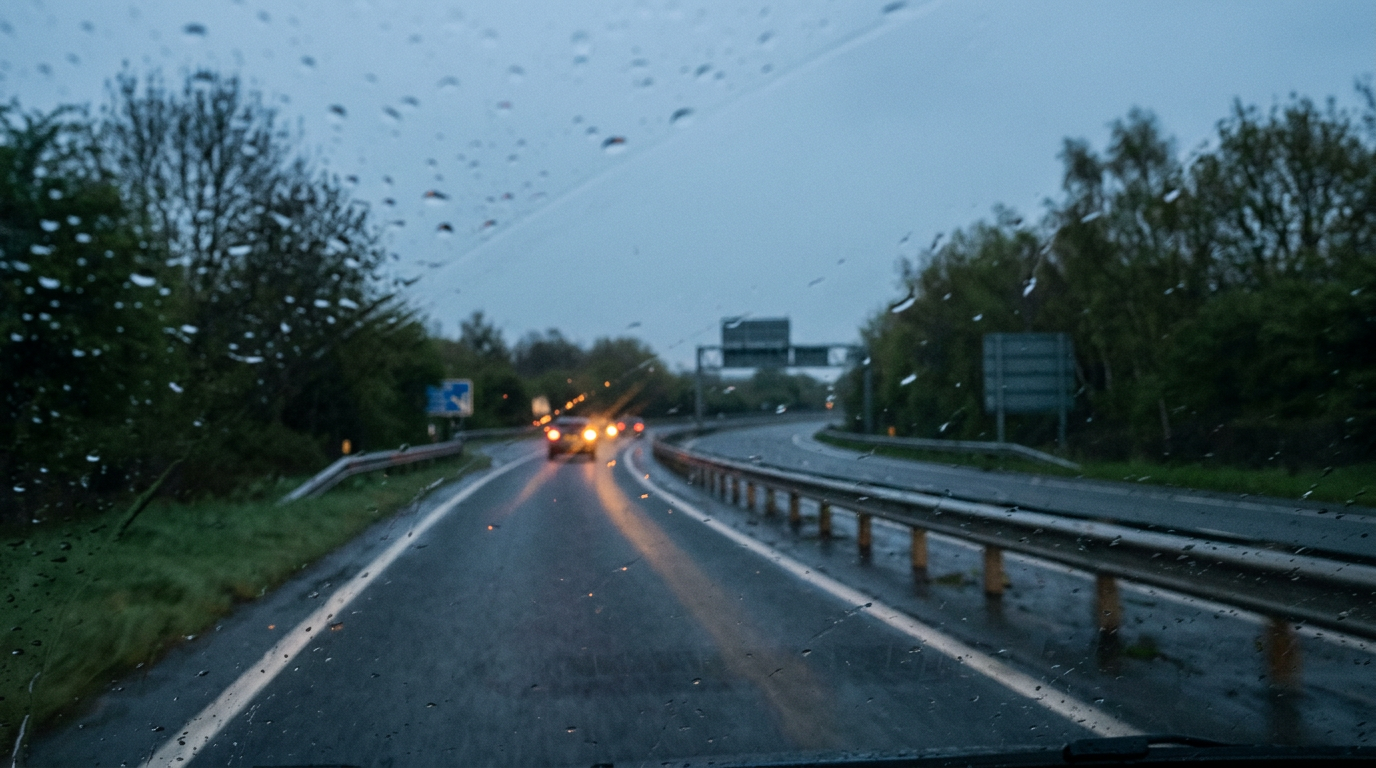
DVSA data shows certain question types trip up learners again and again — stopping distances, dual-carriageway rules, environment, and edge-case Highway Code rules around vulnerable road users. Below are 12 of the toughest questions in the 2026 bank, each followed by the explanation that turns a guess into a confident answer.
Practice Questions & Answers
Q1. What is the overall stopping distance at 70 mph in dry conditions?
A1. 96 m (about 24 car lengths). Thinking 21 m + braking 75 m.
Q2. On a wet road your stopping distance is at least…
A2. Twice the dry-condition distance. Wet roads = double everything.
Q3. On icy roads stopping distance can be up to…
A3. Ten times the dry distance. Black ice is the worst-case scenario.
Q4. Maximum speed limit for a car towing a trailer on a motorway?
A4. 60 mph (and you cannot use the right-hand lane of a 3-lane motorway).
Q5. Minimum gap behind a vehicle in good dry conditions (rule of thumb)?
A5. The 2-second rule (4 seconds in wet, 20 seconds on ice).
Q6. When can you overtake on the left?
A6. When the vehicle ahead is signalling right, in slow-moving lanes of traffic, or on a one-way street.
Q7. What's the alcohol limit in mg of alcohol per 100 ml of breath in England?
A7. 35 µg per 100 ml. (Or 80 mg per 100 ml of blood.) Scotland is lower at 22 µg / 50 mg.
Q8. A flashing amber arrow at traffic lights means…
A8. You may filter past in the direction of the arrow if the road is clear.
Q9. Mini-roundabout: when should you signal?
A9. Signal right on approach if turning right; signal left only just before exiting.
Q10. Cyclist filtering on your inside in slow traffic — what should you do?
A10. Check your mirrors and leave space — never squeeze them against the kerb or change direction.
Q11. Approaching horses being ridden, you should…
A11. Slow down to walking pace, give them at least 2 metres and don't rev the engine.
Q12. When MUST you not use the right-hand lane of a 3-lane motorway?
A12. If you are towing a trailer, driving a goods vehicle over 7.5 t, or a coach over 12 m.
Tips to Pass
- Memorise stopping distances as a sequence: 12, 23, 36, 53, 73, 96 metres.
- Drill the questions you get wrong twice daily until perfect.
- Photograph your incorrect answers and review on your phone.
- Use the official DVSA app for the most authoritative wording.
- Take "hard mode" mocks where you only revisit your weakest topics.
Take the full mock test
Explore more in Driving & Transport or browseall driving theory tests.
Related reading: Most Common Driving Theory Mistakes.
Quick study plan
If you only have a fortnight to prepare, split your time into three blocks. Spend the first few days reading any official handbook or syllabus straight through — don't try to memorise yet, the goal is familiarity. Move on to topic-by-topic revision, focusing on the areas you found least intuitive on the first read. In the final week, switch to timed mock tests under exam conditions; mark every paper ruthlessly and read every explanation, including for questions you got right by guessing. Most candidates improve by 8–12 marks between their first and third mock simply by closing knowledge gaps this way.
Common myths to ignore
Three myths trip up more candidates than any single topic. The first is that "if I sit enough mocks, I'll spot the real questions on test day" — modern UK exam banks contain hundreds of items and the question you see on the day will probably be brand new to you. The second is that you can cram the night before; most assessments reward calm focus more than recent recall, and tired candidates make basic mistakes. The third is that the pass mark is the only thing that matters: aiming for a comfortable buffer of 5–10 marks above the threshold is the single best insurance against an unlucky paper.
What to do on test day
Plan to arrive 15–20 minutes early with valid photo ID — usually a UK driving licence or passport — and any booking confirmation you've been emailed. Eat something light beforehand, drink water but not so much that you'll need a comfort break mid-paper, and silence your phone before you walk through the door. Read every question twice, flag anything you're unsure of, and never leave a blank — there's no negative marking on the assessments most readers of this site sit, so a considered guess is always better than no answer at all.