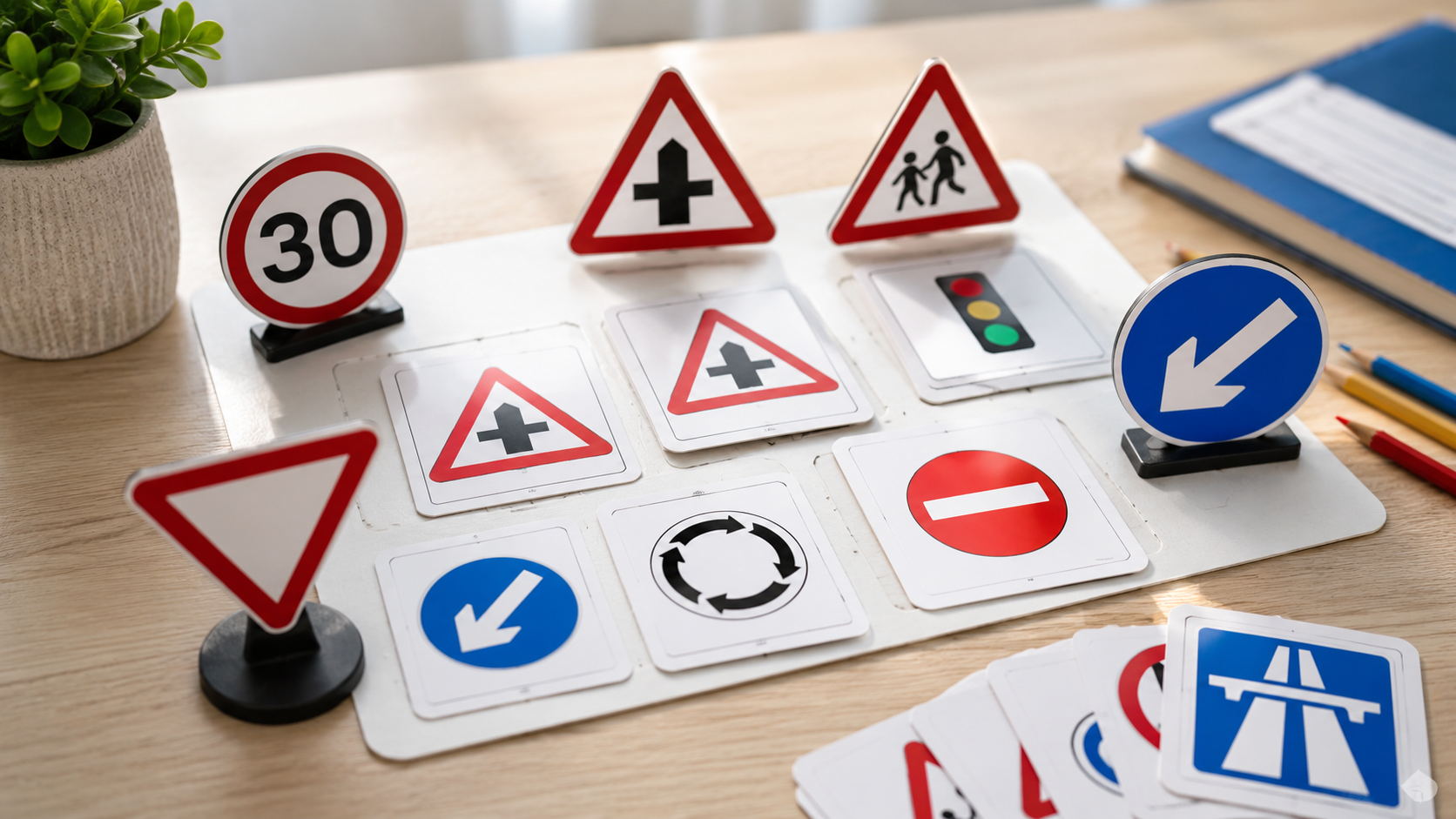
Welcome to Show & Tell — an interactive board for learning UK road signs. Each card below shows a real road sign on the front. Tap any card and it will flip to reveal the sign's name and what it means in plain English.
This is the fastest way to drill the signs you keep forgetting: see the shape, guess the meaning in your head, then flip to check. When you can get every card right without flipping, you're ready for the road signs practice tests .
The interactive board Tap to reveal What it means Cattle grid Warning: a cattle grid crosses the road ahead. Slow down — the metal bars can be slippery, especially when wet.
Tap to reveal What it means Agricultural vehicles Warning: slow-moving agricultural vehicles such as tractors are likely to be on or crossing the road. Be ready to slow down or stop.
Tap to reveal What it means Ford ahead Warning: a ford (shallow river or stream crossing) ahead. Check the depth gauge and drive through slowly in a low gear.
Tap to reveal What it means Try your brakes Plate sign found just after a ford or water splash: test your brakes gently to dry them out before continuing at normal speed.
Tap to reveal What it means Risk of ice Warning: the road ahead may be icy or slippery. Drive smoothly at low speed — avoid harsh braking, steering or acceleration.
Tap to reveal What it means Quayside or river bank Warning: the road runs alongside a quay, dock or river bank with no barrier. Drive slowly and keep well clear of the edge.
Tap to reveal What it means Risk of flooding Warning: the road ahead is liable to flooding, often after heavy rain or near rivers. Slow down and be ready to stop or turn back.
Tap to reveal What it means Uneven road Warning: the road surface ahead is uneven with bumps or dips. Reduce speed to keep control and avoid jolting the vehicle.
Tap to reveal What it means Soft verges Warning: the verges at the side of the road are soft and may give way under a vehicle's weight. Avoid pulling onto them, especially in wet weather.
Tap to reveal What it means Slippery road Warning: the road surface ahead may be slippery. Reduce speed and avoid harsh braking, steering or acceleration.
Tap to reveal What it means Road hump Warning: a road hump or series of humps ahead, used to slow traffic. Reduce speed before reaching them to keep control and comfort.
Tap to reveal What it means Low-flying aircraft Warning: low-flying aircraft or sudden aircraft noise ahead, usually near an airfield. Stay alert as the noise can be startling.
Tap to reveal What it means Low-flying helicopters Warning: low-flying helicopters or sudden helicopter noise ahead. Be ready for unexpected noise that could distract you or other road users.
Tap to reveal What it means Falling or fallen rocks Warning: risk of rocks falling onto the road, or fallen rocks already on the carriageway. Reduce speed and watch the road surface ahead.
Tap to reveal What it means No vehicles Prohibition: no vehicles of any kind allowed (except pedal cycles being pushed). Often used for pedestrian-only areas.
Tap to reveal What it means Other danger Warning: a hazard ahead not covered by other signs. A plate beneath usually describes the danger — slow down and be ready to react.
Tap to reveal What it means Fire station ahead Plate with red lights at a fire station: stop when the lights show, as fire engines may be leaving to attend an emergency.
Tap to reveal What it means Side winds Warning: strong crosswinds likely on the road ahead, often on exposed bridges or open country. Grip the wheel firmly and reduce speed.
Tap to reveal What it means Military vehicles Warning: slow-moving military vehicles, such as tanks, may be on or crossing the road ahead. Be ready to slow down or stop.
Tap to reveal What it means Steep hill downwards Warning: steep descent ahead. Select a low gear before the hill to control speed and avoid overusing the brakes.
Tap to reveal What it means Services Direction sign to motorway service area or roadside services. Blue arrow points the way to fuel, food and rest facilities.
Tap to reveal What it means Keep apart 2 chevrons Keep at least a two-chevron gap from the vehicle in front. Helps drivers judge a safe following distance on high-speed roads.
Tap to reveal What it means Check your distance Reminder plate, often used with chevron markings, to check the gap from the vehicle ahead and drop back if too close.
Tap to reveal What it means Variable speed limit (50 mph) Electronic sign showing a temporary mandatory speed limit (here 50 mph), often used for congestion or roadworks on motorways.
Tap to reveal What it means Lane diversion arrow Matrix sign on a motorway gantry: move from your lane in the direction of the arrow because the lane ahead is closed.
Tap to reveal What it means Lanes available Matrix sign showing which lanes are open ahead. Vertical lines indicate lanes you may continue to use.
Tap to reveal What it means Leave the motorway Red flashing matrix sign: leave the motorway at the next exit because of an incident or closure ahead.
Tap to reveal What it means Lane closed (red X) Red X on an overhead gantry: the lane below is closed. Move out of it as soon as it is safe — do not drive under a red X.
Tap to reveal What it means Fog warning Matrix sign warning of fog ahead. Reduce speed, switch on dipped headlights and use fog lights if visibility drops below 100 m.
Tap to reveal What it means End End of a previously displayed message or restriction (such as a temporary speed limit) on a matrix sign.
Tap to reveal What it means Hazardous goods route (HR) Plate indicating a route to be used by vehicles carrying hazardous goods. Other vehicles may also use it.
Tap to reveal What it means Tourist attraction (steam railway) Brown tourist sign pointing to a nearby visitor attraction — here a steam railway 300 yards ahead.
Tap to reveal What it means Lorry parking with toilets Direction sign to a lorry park with toilet facilities, 1 mile ahead. The arrow shows the route to follow.
Tap to reveal What it means Park and Ride 300 yds Advance direction sign to a Park and Ride site 300 yards ahead — leave your car and continue into town by bus.
Tap to reveal What it means Park and Ride direction Direction sign pointing the way to a Park and Ride car park served by a bus link into the town centre.
Tap to reveal What it means Long stay / short stay parking Parking direction sign showing the routes to long-stay and short-stay car parks.
Tap to reveal What it means Lane open (green arrow) Overhead lane signal: green downward arrow means the lane below is open and you may use it.
Tap to reveal What it means Lane closed (red X) Overhead lane signal: red X means the lane below is closed. Move out of it as soon as it is safe.
Tap to reveal What it means Move to adjacent lane Overhead signal: move into the lane indicated by the diagonal white arrow because the current lane is closing ahead.
Tap to reveal What it means Lorry route Direction sign showing the route lorries should follow to reach numbered roads (here A33 and M1).
Tap to reveal What it means Taxi rank Taxi rank — parking reserved for the indicated number of taxis (here 3). Other vehicles must not stop here.
Tap to reveal What it means Shared route — pedestrians and cyclists Route shared by pedestrians and cyclists with no separation. Cyclists must give way to pedestrians.
Tap to reveal What it means Segregated route — pedestrians and cyclists Separate paths for pedestrians and cyclists, divided by a white line. Keep to the side shown for your mode.
Tap to reveal What it means Tramway — look both ways Warning at a tramway crossing: trams can approach from either direction — look both ways before crossing.
Tap to reveal What it means Bus lane — look right Warning at a contraflow bus lane: buses may be approaching from the right, against the normal traffic flow.
Tap to reveal What it means Start of motorway Start of a motorway (here the M62) and its regulations. Certain vehicles and road users are prohibited.
Tap to reveal What it means End of motorway End of motorway regulations. Motorway rules no longer apply beyond this point.
Tap to reveal What it means End of bus lane End of a bus lane — the lane is no longer reserved for buses and may be used by all traffic.
Tap to reveal What it means End of cycle route End of a cycle route or facility. Cyclists should rejoin the main carriageway or follow other signs.
Tap to reveal What it means Cycle route Route recommended for pedal cycles. Other vehicles are usually prohibited.
Tap to reveal What it means Bus stop Marks a bus stop. Do not park here — buses need clear access for passengers boarding and alighting.
Tap to reveal What it means Tram stop Marks a tram stop. Be aware of trams and passengers crossing the road to reach or leave the stop.
Tap to reveal What it means London bus stop Marks a London bus stop. Buses stop here automatically — do not park or wait in the marked area.
Tap to reveal What it means Request bus stop Buses only stop here if signalled by passengers waiting at the stop or by passengers on board.
Tap to reveal What it means With-flow bus lane Start of a with-flow bus lane that may also be used by local buses, taxis and pedal cycles during its hours of operation.
Tap to reveal What it means With-flow cycle lane Start of a with-flow cycle lane reserved for pedal cycles. Other vehicles must not enter the lane during its hours of operation.
Tap to reveal What it means Lane reserved for bus, cycles and taxis Nearside lane ahead is reserved for local buses, pedal cycles and taxis during its hours of operation.
Tap to reveal What it means Lane reserved for cycles Nearside lane ahead is reserved for pedal cycles during its hours of operation.
Tap to reveal What it means Contraflow bus lane Buses travel in the opposite direction in the lane shown — be aware of buses approaching from ahead.
Tap to reveal What it means Contraflow cycle lane Pedal cycles travel in the opposite direction in the lane shown — be aware of cyclists approaching from ahead.
Tap to reveal What it means Parking Parking place. Used on its own or with a plate showing restrictions or the type of vehicle that may park.
Tap to reveal What it means Goods vehicles plate Plate used with another sign to show that it applies to goods vehicles (lorries).
Tap to reveal What it means Cars plate Plate used with another sign to show that it applies to cars (and similar light vehicles).
Tap to reveal What it means Vehicles being towed away Warning that vehicles parked illegally in the area may be removed (towed away).
Tap to reveal What it means Motorcycles plate Plate used with another sign to show that it applies to solo motorcycles.
Tap to reveal What it means Cycle parking Parking place reserved for pedal cycles.
Tap to reveal What it means Coach parking Parking place reserved for coaches and buses.
Tap to reveal What it means Coach photostop Tourist coaches may stop here briefly between 10 am and 4 pm to allow passengers to take photographs.
Tap to reveal What it means Goods vehicle check point Lane-direction sign: lorries must keep to the left lane for a goods vehicle check point ½ mile ahead. Other vehicles use the right lane.
Tap to reveal What it means Restricted entry ahead Advance warning that entry to the road named (here High Street) is restricted ½ mile ahead.
Tap to reveal What it means Low bridge ahead Advance warning of a low bridge with a maximum headroom (here 4.4 m / 14′ 6″) 2 miles ahead.
Tap to reveal What it means Weight limit with diversion Advance warning of a weight limit on a road ahead, with a suggested alternative route for vehicles over the limit.
Tap to reveal What it means Unsuitable for motor vehicles The road or route ahead is unsuitable for motor vehicles — typically a narrow lane or unmade track.
Tap to reveal What it means Countdown markers Countdown markers at the exit from a motorway or primary route. Each bar represents 100 yards to the start of the slip road.
Tap to reveal What it means Depth gauge Depth gauge at a ford or flooded section of road, showing the depth of water in feet and metres.
Tap to reveal What it means Hospital — no A&E Direction sign to a hospital that does not have an Accident and Emergency department.
Tap to reveal What it means Hospital with A&E (not 24 hrs) Direction sign to a hospital with an Accident and Emergency department that is not open 24 hours a day.
Tap to reveal What it means Police speed check area Warning that police speed-check equipment is in use in the area ahead. Check your speed and keep within the limit.
Tap to reveal What it means Entrance (IN) Entrance to a car park or other facility — vehicles enter here.
Tap to reveal What it means Exit (OUT) Exit from a car park or other facility — vehicles leave here.
Tap to reveal What it means No exit There is no exit from the road or area beyond this sign — used to warn drivers that the route is a dead end.
Tap to reveal What it means No entry (information) Informational sign indicating that there is no entry from this point — vehicles should not enter.
Tap to reveal What it means Tourist information point Direction sign to a tourist information point where visitors can get maps, leaflets and local advice.
Tap to reveal What it means Vehicle testing station Direction sign to a vehicle testing (MOT) station authorised to test vehicles for roadworthiness.
Tap to reveal What it means Motorcycle test centre Direction sign to a motorcycle test centre where the practical motorcycle test is carried out.
Tap to reveal What it means Traffic enforcement camera Traffic enforcement cameras are in use in the area — they may detect speeding, red-light or bus-lane offences.
Tap to reveal What it means Speed camera with limit Speed cameras are in use to enforce the speed limit shown (here 30 mph). Keep within the limit.
Tap to reveal What it means Home zone entry Entry to a Home Zone — a residential area where pedestrians and cyclists have priority. Drive very slowly and give way to people on foot.
Tap to reveal What it means Home zone ends End of a Home Zone — normal driving conditions resume and pedestrians no longer have priority over vehicles.
Tap to reveal What it means Traffic calmed area Entry to a traffic-calmed area where traffic-calming features such as humps, chicanes or narrowings are in use.
Tap to reveal What it means Route for buses and cycles only Route reserved for use by local buses and pedal cycles only. Other vehicles must not enter.
Tap to reveal What it means Route for trams only Route reserved for trams only. Other vehicles must not enter.
Tap to reveal What it means Route for pedal cycles only Route reserved for pedal cycles only. Other vehicles must not enter.
Tap to reveal What it means Cyclists dismount Plate advising cyclists to dismount and push their bicycles, usually at the end of a cycle route or at a hazard.
Tap to reveal What it means Tram speed limit Mandatory maximum speed limit for trams (here 30 mph). Diamond-shaped signs apply to trams only.
Tap to reveal What it means Tourist information Symbol indicating a tourist information point or office where visitors can get advice and leaflets.
Tap to reveal What it means Tourist attraction Brown sign with a white symbol (here a castle) directing you to a tourist attraction or place of historic interest.
Tap to reveal What it means Lane control ahead Advance warning that overhead lane control signals are in use ahead — watch for signals showing which lanes are open or closed.
Tap to reveal What it means One way Traffic on this road flows in one direction only, in the direction of the arrow. Do not drive against the arrow.
Tap to reveal What it means Two-way traffic — give priority to oncoming vehicles Road narrows ahead with two-way traffic. You must give priority to oncoming vehicles (red arrow) before proceeding.
Tap to reveal What it means No through road The road ahead is a dead end (cul-de-sac) with no exit for vehicles. You'll need to turn around to leave.
Tap to reveal What it means No through road on side road The side road branching off ahead is a dead end with no through route for vehicles.
Tap to reveal What it means Escape lane ahead An escape lane (with a gravel or sand arrester bed) is ahead — for vehicles that have lost their brakes on a steep downhill.
Tap to reveal What it means Dual carriageway ahead The road ahead becomes a dual carriageway with a central reservation separating the two directions of traffic.
Tap to reveal What it means Dual carriageway for ½ mile Advance information that a dual carriageway begins in half a mile — be ready for two lanes in your direction with a central reservation.
Tap to reveal What it means Single track road with passing places The road ahead is single track. Use the marked passing places to let oncoming vehicles through or to allow following traffic to overtake.
Tap to reveal What it means Lane gained on the left An additional lane is added on the left ahead — traffic in your lane continues; the new lane provides extra capacity.
Tap to reveal What it means Lane closed ahead (right-hand lane) The right-hand lane is closed ahead. Move into one of the open lanes in good time.
Tap to reveal What it means Lane closed (merge in turn) The left-hand lane is closed ahead — merge in turn with traffic in the open lanes in good time.
Tap to reveal What it means Lane destinations with bus exception Shows which lanes lead to which destinations at the junction ahead. The 'Except buses' plate means the left-turn restriction does not apply to buses.
Tap to reveal What it means Lane destinations — ahead or right At the junction ahead, the left lane is for traffic going straight on and the right lane is for turning right.
Tap to reveal What it means Lane destinations — left or right At the junction ahead, the left lane is for turning left or going ahead and the right lane is for turning right.
Tap to reveal What it means Bus lane on road at junction There is a bus lane on the road being joined at the junction ahead. The arrow shows the direction of bus traffic.
Tap to reveal What it means Cycle lane on road at junction There is a cycle lane on the road being joined at the junction ahead. The arrow shows the direction of cycle traffic.
Tap to reveal What it means Bus and cycle lane There is a lane reserved for buses and pedal cycles on the road being joined at the junction ahead.
Tap to reveal What it means Congestion charging zone Entering a congestion charging zone — drivers must pay a daily charge to drive within the zone during operating hours.
Tap to reveal What it means Ahead only Mandatory instruction to proceed straight ahead. You must not turn left or right.
Tap to reveal What it means Turn left Mandatory instruction to turn left ahead. You must follow the direction shown by the arrow.
Tap to reveal What it means Turn left ahead Mandatory instruction that you must turn left at the junction ahead.
Tap to reveal What it means Keep left Vehicles must pass to the left of the sign — typically used at islands, bollards or refuges.
Tap to reveal What it means Vehicles may pass either side Vehicles may pass either side of the sign to reach the same destination — typically used at islands or obstructions.
Tap to reveal What it means Mini-roundabout Mini-roundabout ahead — give way to traffic from the immediate right and proceed around the central marking in a clockwise direction.
Tap to reveal What it means One-way traffic Traffic on this road flows in one direction only, in the direction of the arrow.
Tap to reveal What it means Maximum speed limit Mandatory maximum speed limit in miles per hour (here 40 mph). You must not exceed this speed.
Tap to reveal What it means National speed limit applies The national speed limit applies on this road — 60 mph for cars on single carriageways and 70 mph on dual carriageways and motorways (lower limits for some vehicles).
Tap to reveal What it means Minimum speed Mandatory minimum speed limit (here 30 mph). You must not drive slower than this speed unless it is unsafe to do so.
Tap to reveal What it means End of minimum speed End of the minimum speed limit shown. The minimum speed restriction no longer applies.
Tap to reveal What it means 20 mph zone Entry to a 20 mph zone — a 20 mph speed limit applies throughout the area, usually with traffic-calming measures such as humps or chicanes.
Tap to reveal What it means End of 30 mph zone End of the 30 mph speed limit zone. The previous speed restriction no longer applies — the national speed limit or next posted limit takes over.
Tap to reveal What it means Speed camera area Warning of speed camera enforcement of the posted limit (here 50 mph). Orange dots indicate camera markings — keep within the limit.
Tap to reveal What it means No waiting No waiting at any time. You must not stop to wait or park, though you may stop briefly to set down or pick up passengers.
Tap to reveal What it means End of loading area End of a designated loading area. Loading and unloading restrictions of the zone you are leaving no longer apply beyond this sign.
Tap to reveal What it means Permit holders only parking Parking reserved exclusively for vehicles displaying a valid permit. Other vehicles must not park here.
Tap to reveal What it means Resident permit holders only Parking restricted to residents holding the permit zones shown (e.g. A, B, C). Vehicles without the correct resident permit must not park here.
Tap to reveal What it means Loading only Bay reserved for loading and unloading goods only. Vehicles must not wait beyond the time needed to load or unload.
Tap to reveal What it means Voucher parking Voucher parking only during the times shown (here Mon–Sat 9 am–6 pm), with a 2 hour maximum stay. Display a valid parking voucher.
Tap to reveal What it means Disabled badge holders only Parking reserved for vehicles displaying a valid Blue Badge. Other vehicles must not park here.
Tap to reveal What it means Have you paid and displayed? Reminder in pay-and-display parking areas to buy a ticket and display it clearly inside the windscreen before leaving the vehicle.
Tap to reveal What it means Disc zone parking Parking disc zone — during the times shown (Mon–Sat 8 am–6 pm) you may park for 30 minutes maximum with a parking disc displayed. No return within 1 hour.
Tap to reveal What it means Controlled parking zone Entry to a controlled parking zone — waiting restrictions apply during the times shown. Parking is only permitted in marked bays.
Tap to reveal What it means Voucher parking zone Entry to a voucher parking zone — during the times shown (Mon–Sat 9 am–6 pm) parking is permitted only with a valid voucher displayed, with a 2 hour maximum stay.
Tap to reveal What it means End of controlled parking zone End of the controlled parking zone — the waiting restrictions of the zone you are leaving no longer apply beyond this sign.
Tap to reveal What it means Goods vehicle restricted zone Entry to a zone where goods vehicles over the weight shown (here 5 tonnes) must not load or unload during the times indicated.
Tap to reveal What it means End of goods vehicle zone End of the goods vehicle restricted zone — the loading restrictions for vehicles over the stated weight no longer apply beyond this sign.
Tap to reveal What it means Parking partly on verge or footway Vehicles may park partly on the verge or footway in the area shown. Take care not to obstruct pedestrians.
Tap to reveal What it means End of partly on verge parking End of the area where vehicles may park partly on the verge or footway. Beyond this point parking partly on the verge is not permitted.
Tap to reveal What it means Parking wholly on verge or footway Vehicles may park wholly on the verge or footway in the area shown. Avoid blocking pedestrian access.
Tap to reveal What it means End of wholly on verge parking End of the area where vehicles may park wholly on the verge or footway. Beyond this point parking on the verge or footway is not permitted.
Tap to reveal What it means No stopping except buses No stopping during the times shown (here 7 am–7 pm) except for buses. Other vehicles must not stop, even briefly.
Tap to reveal What it means Bus stand — no stopping Bus stand: no stopping during the times shown (here 7 am–7 pm) except for buses using the stand. Other vehicles must not stop here.
Tap to reveal What it means STOP You must stop completely at the line and give way to traffic on the major road. Only move off when it is safe to do so.
Tap to reveal What it means Give way Give way to traffic on the major road. Slow down and be prepared to stop if necessary; only proceed when there is a safe gap.
Tap to reveal What it means No right turn Right turn prohibited. You must not turn right at the junction or entrance ahead.
Tap to reveal What it means No left turn Left turn prohibited. You must not turn left at the junction or entrance ahead.
Tap to reveal What it means No U-turns U-turns are not permitted. You must not turn the vehicle around to face the opposite direction at this point.
Tap to reveal What it means Give priority to oncoming vehicles Give priority to vehicles coming from the opposite direction at the narrow section ahead. The red arrow shows oncoming traffic with right of way; you must wait until the road is clear.
Tap to reveal What it means No entry for vehicular traffic No entry for vehicular traffic. You must not drive past this sign — it usually marks the wrong-way end of a one-way street.
Tap to reveal What it means No vehicles No vehicles of any kind permitted beyond this sign (except pedal cycles being pushed). Often used at the entrance to pedestrian areas.
Tap to reveal What it means Pedestrian zone — no vehicles except for loading Entry to a pedestrian zone. No vehicles permitted except goods vehicles loading or unloading at the times shown on the plate.
Tap to reveal What it means Pedestrian zone — loading restrictions Pedestrian zone with no motor vehicles except for loading. The yellow plate shows additional no-waiting restrictions (here at any time).
Tap to reveal What it means End of pedestrian zone End of the pedestrian zone — the vehicle restrictions of the pedestrian zone you are leaving no longer apply beyond this sign.
Tap to reveal What it means No motor vehicles No motor vehicles permitted beyond this sign. Pedal cycles and other non-motorised users may still pass.
Tap to reveal What it means No cars No cars permitted beyond this sign. Other vehicles such as motorcycles, buses or goods vehicles may still pass unless restricted by other signs.
Tap to reveal What it means No motorcycles No solo motorcycles permitted beyond this sign. Other vehicles may still pass unless restricted by other signs.
Tap to reveal What it means No goods vehicles over maximum gross weight shown Goods vehicles over the maximum gross weight shown (here 7.5 tonnes) are prohibited beyond this sign.
Tap to reveal What it means End of goods vehicle restriction End of the restriction on goods vehicles. The weight limit shown previously no longer applies beyond this sign.
Tap to reveal What it means No articulated vehicles Articulated vehicles are prohibited beyond this sign. Other vehicles may still pass unless restricted by other signs.
Tap to reveal What it means No horse-drawn vehicles Horse-drawn vehicles are prohibited beyond this sign.
Tap to reveal What it means No ridden or accompanied horses Ridden or accompanied horses are prohibited beyond this sign.
Tap to reveal What it means No vehicles towing a caravan or trailer Vehicles towing a caravan or trailer are prohibited beyond this sign.
Tap to reveal What it means No vehicles carrying explosives Vehicles carrying explosives are prohibited beyond this sign.
Tap to reveal What it means No pedestrians Pedestrians are prohibited beyond this sign — typically used at the entrance to motorways, tunnels and other roads where walking is not permitted.
Tap to reveal What it means Weak bridge Weak bridge ahead — vehicles over the maximum gross weight shown (here 18 tonnes mgw) must not cross.
Tap to reveal What it means Maximum vehicle width No vehicles wider than the width shown (here 6 ft 6 in) permitted beyond this sign.
Tap to reveal What it means Maximum vehicle length No vehicles longer than the length shown (here 32 ft 6 in) permitted beyond this sign.
Tap to reveal What it means Maximum vehicle height No vehicles taller than the height shown (here 14 ft 6 in) permitted beyond this sign — check overall height including any load.
Tap to reveal What it means No overtaking Overtaking is prohibited beyond this sign until the restriction ends. You must not pass another moving motor vehicle.
Tap to reveal What it means Stop — police Manually operated temporary STOP sign used by the police. You must stop when shown this sign and only proceed when directed.
Tap to reveal What it means School crossing patrol Manually operated STOP sign used by a school crossing patrol. You must stop when shown this sign and wait until the patrol has cleared the crossing.
Tap to reveal What it means No stopping (clearway) Clearway — no stopping at any time, even briefly to set down or pick up passengers, except in an emergency.
Tap to reveal What it means Red Route — no stopping except buses Red Route: no stopping at any time, including to set down or pick up passengers — except for buses. Strict penalties apply.
Tap to reveal What it means Urban clearway — times of operation Urban clearway in operation during the times shown (here Mon–Fri am 8.00–9.30 and pm 4.30–6.30). You may only stop to pick up or set down passengers.
Tap to reveal What it means End of urban clearway End of the urban clearway restrictions. The no-stopping rules of the urban clearway no longer apply beyond this sign.
Tap to reveal What it means No motor vehicles, cycles, animals or pedestrians on mown verge Motor vehicles, cyclists, animals and pedestrians are prohibited from using the mown verge — keep to the carriageway or footway.
Tap to reveal What it means No cycling No pedal cycles permitted beyond this sign. Cyclists must dismount or take an alternative route.
Tap to reveal What it means No buses No buses (vehicles with more than 8 passenger seats) permitted beyond this sign.
Tap to reveal What it means Long vehicle markings Rear markings shown on long vehicles to make them more visible. The red and yellow chevrons are fitted to vehicles over 13 metres long, with 'LONG VEHICLE' plates required on certain combinations.
Tap to reveal What it means Hazard warning plate (HazChem) Plate displayed on vehicles carrying dangerous goods. The codes show the substance, emergency action required and a contact number for the emergency services.
Tap to reveal What it means Plain orange plate Plain orange plate displayed on vehicles carrying dangerous goods in bulk where a specific hazard code is not required. Indicates a hazardous load is on board.
Tap to reveal What it means Toxic substances Diamond placard for class 6 toxic substances. Displayed on vehicles carrying poisonous materials that can cause harm if swallowed, inhaled or absorbed.
Tap to reveal What it means Spontaneously combustible Diamond placard for class 4 spontaneously combustible substances. Displayed on vehicles carrying materials that can ignite without an external source.
Tap to reveal What it means Radioactive Diamond placard for class 7 radioactive substances. Displayed on vehicles carrying radioactive materials.
Tap to reveal What it means Compressed gas Diamond placard for class 2 compressed gases. Displayed on vehicles carrying gases under pressure, which may be flammable, toxic or asphyxiating.
Tap to reveal What it means Corrosive Diamond placard for class 8 corrosive substances. Displayed on vehicles carrying materials that can damage skin, metal or other surfaces on contact.
Tap to reveal What it means Oxidizing agent Diamond placard for class 5.1 oxidizing substances. Displayed on vehicles carrying materials that can intensify a fire by releasing oxygen.
Tap to reveal What it means Projection markers Red and white striped end markers fitted to vehicles carrying loads that project beyond the front or rear, to make the projecting load more visible to other road users.
Tap to reveal What it means Cycle lane road marking Road marking showing a cycle lane reserved for pedal cycles, indicated by a bicycle symbol painted on the carriageway.
Tap to reveal What it means Mini-roundabout road marking Circular road marking with arrows indicating a mini-roundabout. Give way to traffic from the right and proceed clockwise around the marking.
Tap to reveal What it means Box junction at side roads Yellow criss-cross road markings at side road junctions. You must not enter the box unless your exit is clear, except when turning right and only blocked by oncoming traffic.
Tap to reveal What it means Box junction Yellow criss-cross road marking at a junction. You must not enter the box unless your exit is clear, except when turning right and only blocked by oncoming traffic or other right-turning vehicles.
Tap to reveal What it means Lane line Short broken white line across the carriageway dividing traffic lanes travelling in the same direction. You may cross it when safe to change lanes.
Tap to reveal What it means Double white lines (both solid) Two solid white lines along the centre of the road. You must not cross or straddle them except to turn into a side road or property, pass a stationary vehicle, or overtake a pedal cycle, horse or road maintenance vehicle travelling at 10 mph or less.
Tap to reveal What it means Lane change arrows Road marking with arrows indicating that traffic must move into the lane shown — used where lanes merge or a lane is closed ahead. Move over in good time.
Tap to reveal What it means Edge of carriageway line Continuous solid white line marking the edge of the carriageway. It helps you judge the road's edge in poor visibility and should not normally be crossed.
Tap to reveal What it means Road with no centre markings An unmarked single carriageway with no centre line. Drive with extra care — assume oncoming vehicles may be close to the middle and keep well to the left.
Tap to reveal What it means Lane line Short broken white lines separating lanes of traffic travelling in the same direction. You may cross the line to change lanes when it is safe.
Tap to reveal What it means Centre line Broken white line down the centre of the road with short marks and long gaps, separating opposing flows of traffic. You may cross it to overtake when safe.
Tap to reveal What it means Hazard warning line Broken white centre line with longer marks and shorter gaps. It warns of a hazard ahead such as a bend, junction or change in road layout — do not cross unless you can see the road is clear.
Tap to reveal What it means Double white lines (one solid, one broken) Centre lines with one solid and one broken white line. If the line nearest you is broken you may cross to overtake when safe; if the line nearest you is solid you must not cross or straddle it except in limited circumstances.
Tap to reveal What it means Areas of white diagonal stripes or chevrons Hatched road markings used to separate traffic streams or protect turning traffic. If bordered by a broken line do not enter unless necessary; if bordered by a solid white line you must not enter except in an emergency.
Tap to reveal What it means Give way lines Two broken white lines across the road at a junction marking a give way. Slow down and give way to traffic on the major road before emerging.
Tap to reveal What it means Chevron markings between lanes Diagonal chevron markings bordered by solid white lines separating opposing traffic flows. You must not enter the chevron area except in an emergency.
Tap to reveal What it means Warning lines along the edge Diagonal stripes painted along the side of the carriageway warning of a hazard or narrowing road. Stay within your lane and do not cross the solid border.
Tap to reveal What it means Lane closure arrow Large curved white arrow on the carriageway directing you to move into the lane indicated. The lane ahead is closing — change lanes in good time.
Tap to reveal What it means Single yellow line A single yellow line along the kerb means waiting is restricted during the times shown on nearby signs. Loading and unloading may be allowed unless kerb marks indicate otherwise.
Tap to reveal What it means Double yellow lines Double yellow lines along the kerb mean no waiting at any time. You may stop only briefly to set down or pick up passengers, unless additional kerb marks ban loading.
Tap to reveal What it means Edge of carriageway marking A short yellow mark on the kerb or edge of the carriageway indicates loading restrictions in force at the times shown on nearby plates.
Tap to reveal What it means Red route — double red lines Double red lines along a Red Route mean no stopping at any time, for any reason — not even to pick up or set down passengers, except for licensed taxis or Blue Badge holders where signed.
Tap to reveal What it means Red route — single red line A single red line along a Red Route means no stopping during the times shown on nearby signs. Outside those hours normal parking rules apply.
Tap to reveal What it means Red route parking bay A broken white box marked on a Red Route shows where parking is permitted. The accompanying sign states the days, times and maximum stay allowed.
Tap to reveal What it means Red route loading bay A broken red box on a Red Route marks a bay where loading and unloading is allowed during the times shown on the sign. No other stopping is permitted.
Tap to reveal What it means Bus stop clearway Yellow 'BUS STOP' road marking inside a bus stop box. Other vehicles must not stop within the marked area during its hours of operation.
Tap to reveal What it means Keep clear markings at side road White 'keep clear' markings across a side-road entrance show that you must not stop or park on this area, keeping the access free for turning vehicles.
Tap to reveal What it means Centre island / hazard marker Vertical yellow markings on a kerb or refuge highlight a traffic island or central hazard in the road. Pass with care, keeping to the correct side.
Tap to reveal What it means Taxi rank Yellow 'TAXI' road markings within a bay reserve the area for licensed taxis. Other vehicles must not stop or wait in the rank.
Tap to reveal What it means Bus lane road marking 'BUS LANE' painted on the carriageway shows a lane reserved for buses (and usually cycles and taxis) during the times shown on nearby signs. Other vehicles must keep out during those hours.
Tap to reveal What it means Bus stop / cycle area markings Road markings showing dedicated areas for buses or cycles at a stop. Do not stop or park within these markings — they must be kept clear for the vehicles they serve.
Tap to reveal What it means Loading only bay A marked bay reserved for goods vehicles loading and unloading, shown by 'Loading only' kerb signage. Other vehicles must not park here during the times indicated.
Tap to reveal What it means Parking bays White rectangles marked along the kerb show designated parking bays. Park wholly within a bay and follow any time limit or permit conditions on nearby signs.
Tap to reveal What it means Stop line and give way triangle A solid white stop line with a 'give way' triangle painted on the road. Slow down and give way to traffic on the major road; stop behind the line if necessary.
Tap to reveal What it means Chevron distance markings White chevrons painted on the carriageway. Keep at least two chevrons between you and the vehicle in front to maintain a safe separation distance.
Tap to reveal What it means Hard shoulder edge line Solid white line marking the edge of the main carriageway on a motorway, separating it from the hard shoulder. Do not drive on the hard shoulder except in an emergency or when directed.
Tap to reveal What it means Amber reflective road studs Amber reflective studs mark the right-hand edge of the carriageway on a motorway or dual carriageway, separating it from the central reservation.
Tap to reveal What it means Double white lines (both solid) Two solid white lines along the centre of the road. You must not cross or straddle them except in limited circumstances such as turning into a property or passing a slow-moving vehicle travelling at 10 mph or less.
Tap to reveal What it means Centre line Broken white centre line with short marks and long gaps separating opposing flows of traffic. You may cross it to overtake when it is safe to do so.
Tap to reveal What it means Hazard warning line Broken white centre line with longer marks and shorter gaps. It warns of a hazard ahead such as a bend or junction — do not cross unless you can see the road is clear.
Tap to reveal What it means Lane line Short broken white line separating lanes of traffic travelling in the same direction. You may cross it to change lanes when it is safe.
Tap to reveal What it means Dual carriageway with road studs A dual carriageway with reflective road studs marking lane and edge lines. White studs separate lanes, red mark the left edge, amber the right edge alongside the central reservation.
Tap to reveal What it means Give way triangle (road marking) Large white triangle painted on the road pointing towards you. It warns that you must give way to traffic on the major road ahead.
Tap to reveal What it means STOP road marking The word 'STOP' painted on the carriageway, used with a stop line and STOP sign. You must stop completely behind the line and only move off when it is safe.
Tap to reveal What it means Give way triangle (road marking) Inverted white triangle painted on the carriageway warning that you must give way to traffic on the major road ahead.
Tap to reveal What it means SLOW road marking The word 'SLOW' painted on the carriageway warns you to reduce speed because of a hazard ahead such as a bend, junction or change in road conditions.
Tap to reveal What it means HIGH VEHS road marking 'HIGH VEHS' painted on the road warns drivers of high vehicles of a low bridge or overhead obstruction ahead. Tall vehicles should follow the indicated route or reduce height where appropriate.
Tap to reveal What it means KEEP CLEAR road marking 'KEEP CLEAR' painted on the road, often outside school entrances or junctions. You must not stop or park on this area so the access remains clear at all times.
Tap to reveal What it means With-flow bus and cycle lane diagram Diagram of a road with a with-flow bus lane on the nearside. Buses, cycles and taxis use the bus lane during its hours of operation; other traffic uses the remaining lanes.
Tap to reveal What it means Diagonal hatched markings Areas of diagonal white stripes used to separate traffic streams or protect turning vehicles. If bordered by a broken line do not enter unless necessary; if bordered by a solid line do not enter except in an emergency.
Tap to reveal What it means Lane destination markings Arrows and place names painted on the carriageway show where each lane leads. Get into the correct lane in good time for your destination.
Tap to reveal What it means Turn left arrows in lanes 'TURN LEFT' arrows painted in the lanes mean traffic in those lanes must turn left at the junction ahead. Move into the correct lane early.
Tap to reveal What it means Ahead only arrows in lanes 'AHEAD ONLY' arrows painted in the lanes mean traffic in those lanes must continue straight on. Do not turn left or right from these lanes.
Tap to reveal What it means Turn right arrows in lanes 'TURN RIGHT' arrows painted in the lanes mean traffic in those lanes must turn right at the junction ahead. Move into the correct lane early.
Tap to reveal What it means Lane direction arrows at junction Arrows painted in each lane indicate the permitted direction of travel at the junction ahead — left, ahead or right. Choose your lane in good time according to where you are going.
Tap to reveal What it means Get-in-lane arrows Curved arrows painted on the carriageway tell you to move into the lane indicated. Change lanes early and smoothly — do not leave it until the last moment.
Tap to reveal What it means Two-way priority arrow Two arrows pointing in opposite directions painted on the carriageway. Used at narrow sections to show that traffic flows in both directions — give way to oncoming vehicles where indicated.
Tap to reveal What it means NO ENTRY road marking 'NO ENTRY' painted on the carriageway reinforces a no-entry sign. You must not drive past this point — the road is closed to traffic in this direction.
Tap to reveal What it means BUS LANE road marking 'BUS LANE' painted on the carriageway shows a lane reserved for buses (and usually cycles and taxis) during the times shown on nearby signs. Other vehicles must keep out during those hours.
Tap to reveal What it means Lane merge arrows Arrows painted on the carriageway showing two lanes joining into one. Merge in turn with traffic in the adjoining lane and adjust your speed to fit in safely.
Tap to reveal What it means Cycle road marking A bicycle symbol painted on the carriageway indicating a cycle lane or cycle route. Other vehicles must not drive or park in the lane during its hours of operation.
Tap to reveal What it means END road marking The word 'END' painted on the carriageway shows the end of a special lane or restriction such as a bus lane or cycle lane. Normal road rules resume from this point.
Tap to reveal What it means SLOW road marking The word 'SLOW' painted on the carriageway warns you to reduce speed because of a hazard ahead such as a bend, junction or change in road conditions.
Tap to reveal What it means Lane direction arrows (left and ahead) Arrows painted in the lanes show the permitted directions of travel — turn left from the left lane, continue straight ahead from the right lane. Choose your lane in good time.
Tap to reveal What it means Sign shapes — circles and squares Sign shapes carry meaning at a glance: circles give orders (red bordered = prohibition, blue = mandatory), and rectangles give information.
Tap to reveal What it means Give way arrow A large white arrow chevron painted on the carriageway. It indicates that you must give way to oncoming traffic at the narrow section ahead.
Tap to reveal What it means Speed limit roundels Speed-limit roundels (e.g. '30') painted on the carriageway remind you of the limit in force on that road. Reduce or maintain your speed accordingly.
Tap to reveal What it means Road works Red triangular warning sign showing a workman digging — road works ahead. Slow down, watch for workers and obey any temporary signs or speed limits.
Tap to reveal What it means Loose chippings Warning: loose chippings on the road surface ahead. Reduce speed to avoid throwing stones at other vehicles or losing grip, especially on bends.
Tap to reveal What it means Traffic signals not in use Traffic light symbol with a diagonal line through it. The signals ahead are out of order — proceed with caution and treat the junction as an unmarked one, giving way as needed.
Tap to reveal What it means Sign not in use A 'SIGN NOT IN USE' plate covers or accompanies a sign that is temporarily not applicable, often during road works. Ignore the covered sign until the plate is removed.
Tap to reveal What it means Stop / Works (manually operated) Hand-held 'STOP/WORKS' sign used by a road worker to control traffic at road works. When the STOP face is shown you must stop until the sign is turned to allow you to proceed.
Tap to reveal What it means New speed limit ahead Temporary plate warning that a new speed limit (e.g. 30 mph) is now in force on this road. Adjust your speed to comply with the new limit.
Tap to reveal What it means Traffic cone Red and white traffic cone used to mark off lanes, road works or hazards. Do not drive over or between cones unless directed.
Tap to reveal What it means Traffic delineator post Red and white delineator (bollard) used to separate lanes or guide traffic around hazards and road works. Keep to your side of the post.
Tap to reveal What it means Sharp deviation of route (chevrons) Red and white chevron arrows indicate a sharp change in road direction — follow the direction of the arrows around the bend or hazard.
Tap to reveal What it means Road humps Plate showing the profile of road humps ahead, used to slow traffic. Reduce speed and drive over them carefully.
Tap to reveal What it means Works access Marks the entrance used by site vehicles entering road works. Watch for slow-moving works traffic turning in.
Tap to reveal What it means Works exit Marks the point where site vehicles leave road works and rejoin the road. Be ready for slow lorries pulling out.
Tap to reveal What it means Works traffic — direction Direction sign for works traffic, with an arrow showing the route site vehicles should follow into or through road works.
Tap to reveal What it means Works traffic — turn left Rectangular direction plate showing site vehicles to turn left into the works access. Watch for slow lorries turning across your path.
Tap to reveal What it means Works traffic — bear left (flag) Flag-shaped direction sign pointing works traffic to the left along a temporary route. Be alert for site vehicles entering or crossing the road.
Tap to reveal What it means Works traffic merging ahead Warning that works traffic will be merging with the main carriageway in the distance shown (e.g. 200 yds). Be ready to give way and adjust speed.
Tap to reveal What it means Delays possible until (date) Advance information sign warning of likely delays due to road works over a given distance and until a stated date. Allow extra time or consider an alternative route.
Tap to reveal What it means Highways Agency scheme information Information sign giving the road number, name of a Highways Agency improvement scheme and its expected opening date.
Tap to reveal What it means Utility works information Information sign from a utility company (e.g. water main renewal) giving the contractor, completion date and an emergency contact number.
Tap to reveal What it means No hard shoulder for distance Warning that the hard shoulder is closed or unavailable for the stated distance — typically because of road works. Do not use it except in a genuine emergency.
Tap to reveal What it means Convoy system in operation ahead Warning that traffic ahead is being led through road works in a convoy behind a pilot vehicle. Be ready to stop and wait, then follow the convoy at the controlled speed.
Tap to reveal What it means Convoy system to protect workforce Explains that a convoy system is being used to protect road workers. Follow the pilot vehicle and obey signals — do not overtake.
Tap to reveal What it means When red light shows, wait here for convoy vehicle Stop at this point when the red light is showing and wait for the convoy (pilot) vehicle to lead you through the works.
Tap to reveal What it means When green light shows, follow convoy vehicle When the green light shows, move off and follow the convoy (pilot) vehicle through the road works at the speed it sets.
Tap to reveal What it means Convoy vehicle — no overtaking While being led by the convoy (pilot) vehicle through road works, you must not overtake it or any vehicle in the convoy.
Tap to reveal What it means Narrow lanes ahead with width restriction Advance sign warning of narrow lanes through road works, with a width limit applying to one lane (e.g. 6'6"). Wider vehicles must use the other lane(s) and follow the route shown.
Tap to reveal What it means Lane closed ahead Diagram showing that a lane is closed ahead (red bars). Move into an open lane in good time before the closure.
Tap to reveal What it means Lane crossover ahead Warning that traffic is being diverted across to the opposite carriageway through a contraflow. Reduce speed and follow the lane markings carefully.
Tap to reveal What it means Move to adjacent lane Instruction to move from your current lane into the adjacent lane shown by the arrow because of road works ahead.
Tap to reveal What it means Temporary hazard warning Yellow temporary plate carrying a hazard sign on a flexible backing — used at road works to warn of a hazard such as a closure or obstruction ahead.
Tap to reveal What it means Free recovery — await rescue If you break down in road works on a motorway or major road, free recovery is available. Stay with your vehicle in a safe place and await rescue.
Tap to reveal What it means Maximum speed (advisory) Advisory maximum speed (e.g. 30 mph) through road works. Drive at or below this speed for the safety of road workers and other traffic.
Tap to reveal What it means Speed limit ahead Advance warning that a mandatory speed limit (e.g. 50 mph) begins in the distance shown. Be ready to slow down to that limit.
Tap to reveal What it means Works access only Marks a side road or entrance reserved for site vehicles accessing road works. Other traffic must not enter.
Tap to reveal What it means Lane available — works traffic crossing Lane diagram with distance plate showing that lanes remain open but works traffic will be crossing or joining ahead. Be alert for slow site vehicles.
Tap to reveal What it means Keep left / right (temporary) Temporary 'keep left' or 'keep right' bollards/signs at road works. Pass on the side indicated by the arrow.
Tap to reveal What it means Highway maintenance Sign displayed on or near highway maintenance vehicles and works to identify the activity. Pass with care and follow any directions given by workers.
Tap to reveal What it means Slow — wet tar Warning of freshly laid tar or surface dressing on the road. Slow down to avoid skidding and to prevent stones being thrown up.
Tap to reveal What it means When red light shows, wait here Stop at this point when the red light is showing at temporary traffic signals at road works. Wait until the light turns green before proceeding.
Tap to reveal What it means No road markings for distance Warning that road markings (lane lines, centre lines) are absent for the stated distance, often after resurfacing. Take extra care positioning your vehicle.
Tap to reveal What it means New roundabout ahead Advance warning that a new roundabout has been built on this road. Be ready to slow down and give way to traffic from the right.
Tap to reveal What it means Crossing not in use Indicates that a pedestrian crossing is temporarily out of use, often during road works. Pedestrians should use an alternative crossing point.
Tap to reveal What it means Pedestrians look left Reminds pedestrians to look left for approaching traffic before crossing — used where the normal direction of traffic flow has been altered.
Tap to reveal What it means Pedestrians — direction to crossing Directs pedestrians to a temporary crossing point or footway in the direction of the arrow, typically around road works.
Tap to reveal What it means Traffic under signal control Warns that traffic in both directions is being controlled by temporary traffic signals. Obey the signals and be ready to stop.
Tap to reveal What it means Joining traffic not signal controlled Warns that traffic joining from a side road or works access is not controlled by the temporary signals. Watch for vehicles pulling out.
Tap to reveal What it means Stop (manually operated) Hand-held STOP face used by a road worker to control traffic at road works. You must stop and wait until the sign is turned to GO.
Tap to reveal What it means Go (manually operated) Hand-held GO face shown by a road worker — you may now proceed past the works at a safe speed.
Tap to reveal What it means Portable (temporary) traffic signals Portable traffic signals used to control traffic at road works. Obey the signals as you would any normal traffic light.
Tap to reveal What it means Level crossing with barrier or gate ahead Warning of a level crossing ahead that has a gate or barrier. Be ready to stop if the barriers begin to lower or lights show.
Tap to reveal What it means Level crossing without barrier or gate ahead Warning of an unprotected level crossing ahead — no gate or barrier. Look and listen for trains and only cross when it is safe.
Tap to reveal What it means Trams crossing ahead Warning that trams cross or run along the road ahead. Take extra care — trams cannot stop or steer to avoid you.
Tap to reveal What it means Stop when lights show Used at level crossings, swing bridges, fire and ambulance stations: you must stop when the red lights flash and not proceed until they go out.
Tap to reveal What it means Level crossing without barrier St Andrew's cross marker placed at the stop line of a level crossing without a barrier or gate. Stop here when the lights show.
Tap to reveal What it means Another train coming At a level crossing, this sign warns that even though one train has just passed, another train is coming. Do not cross until the lights stop flashing.
Tap to reveal What it means Railway level crossing (symbol) Symbol used to indicate a railway level crossing, often on map-type signs or as a route marker.
Tap to reveal What it means Tramway (symbol) Symbol used to indicate a tramway or tram crossing, often on map-type signs or route markers.
Tap to reveal What it means Overhead electric cable Warning of an overhead electric cable ahead — a plate normally states the maximum safe height for vehicles passing beneath.
Tap to reveal What it means Level crossing with barrier Marker showing a level crossing with a barrier or gate. Stop when the lights flash and wait until the barrier lifts.
Tap to reveal What it means Risk of grounding Warning of a hump bridge, ramp or change of slope where long, low vehicles risk grounding (hitting the road surface) underneath.
Tap to reveal What it means Drivers of long low vehicles — phone before crossing At a level crossing, drivers of long or low vehicles must phone the signal operator from the railway telephone before crossing to check it is safe.
Tap to reveal What it means Drivers of large or slow vehicles — phone for permission At a level crossing, drivers of large or slow vehicles must phone the signaller and get permission to cross. Large means over 61'6" long, 9'6" wide or 44 tonnes; slow means 5 mph or less.
Tap to reveal What it means Railway telephone Indicates the position of a railway telephone at a level crossing — used to contact the signal operator before crossing or in an emergency.
Tap to reveal What it means Countdown markers to level crossing Countdown markers (three, two, one bar) showing the distance to a level crossing ahead.
Tap to reveal What it means New level crossing control ahead Warning that the type of control at a level crossing ahead has been changed — be alert for new signals, barriers or signs.
Tap to reveal What it means Tram driver signals (direction arrows) Special signals for tram drivers — illuminated white arrows show the direction the tram may take. Other road users should ignore these signals.
Tap to reveal What it means Tram signal — proceed White 'proceed' signal for trams (a white asterisk on a black disc). Only applies to tram drivers; other road users follow normal traffic signals.
Tap to reveal What it means Level crossing light signals Red/amber light signals at a level crossing. When the amber light shows you must stop unless it is unsafe to do so; flashing red lights mean stop and wait.
Tap to reveal What it means School crossing patrol School crossing patrol (lollipop person) signalling traffic to stop. You must stop and wait until the patrol leaves the road.
Tap to reveal What it means Police signal — stop traffic approaching from the front Police officer facing you with one arm raised — you must stop. Used to halt traffic approaching from the front.
Tap to reveal What it means Police signal — stop traffic approaching from behind Police officer with back to traffic and arm extended sideways — used to stop traffic approaching from behind.
Tap to reveal What it means Police signal — stop traffic from both front and behind Police officer with one arm raised and the other extended — used to stop traffic approaching from both directions.
Tap to reveal What it means Police signal — beckoning on from the front Police officer beckoning with a sweeping arm movement to signal traffic to come on from the front.
Tap to reveal What it means DVSA / traffic officer signal DVSA officer or traffic officer signalling you to pull in or stop. You must obey their signals just as you would a police officer's.
Tap to reveal What it means Arm signal — I intend to slow down or stop Right arm extended from the window with the palm down, moved slowly up and down — tells other road users you intend to slow down or stop.
Tap to reveal What it means Arm signal — I intend to move in to the left or turn left Right arm rotated in an anticlockwise circular motion — tells other road users you intend to move in to the left or turn left.
Tap to reveal What it means Arm signal — I intend to move out to the right or turn right Right arm extended horizontally from the window — tells other road users you intend to move out to the right or turn right.
Tap to reveal What it means Direction indicator — left Flashing left indicator shown by a car or motorcycle — the driver intends to move in to the left or turn left.
Tap to reveal What it means Direction indicator — right Flashing right indicator shown by a car or motorcycle — the driver intends to move out to the right or turn right.
Tap to reveal What it means Hazard warning lights All four indicators flashing together — used to warn other road users that the vehicle is a temporary hazard, e.g. broken down or slowing rapidly.
Tap to reveal What it means Brake lights Brake lights show that the driver is braking. Keep a safe distance behind so you can react if the vehicle slows or stops.
Tap to reveal What it means Flashing amber lights Flashing amber lights warn of a hazard ahead. Examples: Belisha beacons at a zebra crossing or amber lights flashing on a school bus or hazard sign.
Tap to reveal What it means Flashing amber lights with hazard sign (cattle) Flashing amber lights mounted above a warning sign (e.g. cattle crossing) — they activate when the hazard is present. Slow down and be ready to stop.
Tap to reveal What it means Pedestrian signal — red Red figure at a pedestrian crossing — do not start to cross. Wait for the green figure to show.
Tap to reveal What it means Crossroads ahead Warning of a crossroads ahead. Watch for traffic emerging from or turning into the side roads.
Tap to reveal What it means T-junction with priority over vehicles from the right Warning of a T-junction ahead where the side road joins from the left. The black bar shows the priority road.
Tap to reveal What it means Stop ahead Advance warning that a STOP sign and stop line are ahead at the distance shown. Be ready to stop and give way.
Tap to reveal What it means Give way ahead Advance warning that a GIVE WAY sign is ahead at the distance shown. Be ready to give way to traffic on the major road.
Tap to reveal What it means Side road on the right Warning of a side road joining the main road on the right. Watch for traffic emerging or turning across your path.
Tap to reveal What it means Staggered junction Warning of a staggered junction ahead — side roads join from opposite sides of the main road, but not directly opposite each other.
Tap to reveal What it means Traffic merges from the left Warning that traffic from a slip road or minor road will be merging with the main road from the left.
Tap to reveal What it means Sharp deviation of route to the right Warning of a sharp change of road direction to the right ahead. Reduce speed and follow the bend carefully.
Tap to reveal What it means Roundabout ahead Warning of a roundabout ahead. Slow down, look for traffic coming from the right, and be ready to give way.
Tap to reveal What it means Sharp bend to the right Warning of a sharp bend to the right ahead. Reduce speed before the bend and stay well to the left.
Tap to reveal What it means Double bend, first to the right Warning of two bends ahead, the first to the right. Reduce speed and be ready for the second bend immediately after.
Tap to reveal What it means Reduce speed now Plate used with a hazard warning sign telling you to reduce your speed straight away because of a hazard close ahead.
Tap to reveal What it means Bend to the right Warning of a bend to the right ahead. Adjust your speed to take the bend safely.
Tap to reveal What it means Double bend, first to the left Warning of two bends ahead, the first to the left. Reduce speed and be ready for the second bend immediately after.
Tap to reveal What it means Sharp deviation of route to the left Black and white chevron arrows showing a sharp change of road direction to the left. Follow the direction of the arrows around the bend or hazard.
Tap to reveal What it means Road narrows on both sides Warning that the road narrows on both sides ahead. Be ready to slow down and give way as appropriate.
Tap to reveal What it means Road narrows on the right Warning that the road narrows on the right side ahead — for example, where a hard shoulder or extra lane ends.
Tap to reveal What it means Road narrows on the left Warning that the road narrows on the left side ahead. Adjust your position and be ready to give way.
Tap to reveal What it means Two-way traffic straight ahead Warning that two-way traffic is on the road ahead, often after a one-way section. Keep to the left and watch for oncoming vehicles.
Tap to reveal What it means Two-way traffic crosses one-way road Warning that a one-way road ahead is crossed by a two-way road. Watch for traffic coming from both directions.
Tap to reveal What it means Steep descent Warning of a steep downhill gradient ahead (e.g. 10%). Use a low gear and brake gently to control your speed.
Tap to reveal What it means Steep ascent Warning of a steep uphill gradient ahead (e.g. 20%). Change to a lower gear in good time to keep momentum.
Tap to reveal What it means Hump bridge Warning of a hump bridge ahead. Slow down — your view of oncoming traffic is restricted and the crest may unsettle the vehicle.
Tap to reveal What it means Traffic calming hazard markers Yellow and black hazard markers used to highlight traffic calming features such as islands or bollards. Pass with care.
Tap to reveal What it means Tunnel ahead Warning of a tunnel ahead. Switch on dipped headlights, remove sunglasses and keep a safe distance from the vehicle in front.
Tap to reveal What it means Available headroom Warning of restricted headroom ahead. The plate shows the available height in imperial (14′ 6″) and metric (4.4 m) — do not proceed if your vehicle is taller.
Tap to reveal What it means Road works hazard markers Yellow and black chevron markers used at road works or temporary obstructions to highlight a hazard. Pass slowly and with care.
Tap to reveal What it means Hump bridge with height limit Warning of a hump bridge ahead with limited headroom (12′ 6″ / 3.8 m). Slow down and do not proceed if your vehicle exceeds the height shown.
Tap to reveal What it means Traffic signals ahead Warning of traffic signals ahead. Be ready to stop — signals may be on a junction, pedestrian crossing or temporary at road works.
Tap to reveal What it means Pedestrians in road ahead Warning that pedestrians may be walking in the road ahead, often where there is no pavement. Slow down and be ready to give way.
Tap to reveal What it means Pedestrians likely to cross Warning that pedestrians, including children, are likely to cross the road ahead. Reduce speed and watch carefully.
Tap to reveal What it means Frail or disabled pedestrians Warning of frail, elderly or disabled pedestrians likely to cross the road ahead. Slow down and give them plenty of time.
Tap to reveal What it means School crossing patrol Warning of a school crossing patrol ahead. Slow down and be ready to stop when the patrol shows the STOP sign.
Tap to reveal What it means Cattle Warning that cattle may be on or crossing the road ahead. Slow down and be ready to stop — do not sound your horn or rev your engine.
Tap to reveal What it means Sheep Warning that sheep may be on or crossing the road ahead. Slow down and be ready to stop, especially in open countryside.
Tap to reveal What it means Wild horses or ponies Warning that wild horses or ponies may be on or crossing the road ahead. Slow down and pass with care.
Tap to reveal What it means Accompanied horses or ponies Warning of accompanied horses or ponies on the road ahead. Slow down, pass slowly and give them plenty of room.
How to use this page Cover the meaning. Before you flip a card, say the sign's meaning out loud or in your head.Flip to check. If you were right, move on. If you were wrong, flip back, study the shape, and revisit it after the next five cards.Repeat in short bursts. Five minutes a day for a week beats one long session. The signs will start appearing in your head the moment you see the shape.Then take a mock. Once you can flip the whole board with no mistakes, jump into a road signs mock test to lock it in under exam conditions.Why this works for the theory test UK road signs follow a strict colour and shape system — red triangles warn, red circles prohibit, blue circles instruct, green and blue rectangles direct. Once your eye recognises the shape, the meaning follows almost automatically. Flashcards train exactly that recall: pair a visual with its meaning, then test the link. It's the same technique DVSA examiners recommend in their official learning materials.
For the full reference — every shape, colour and category — see our Complete UK Road Signs Reference .